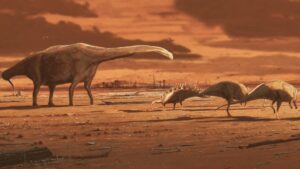
We are all familiar with the Jurassic Park franchise but besides the hype and science fiction, how do palaeontologists actually go about looking for and studying fossils? For the last ten years researchers at the University of Edinburgh and Oxford University have, each year, been patiently crawling across the beaches of the Isle of Skye, Eigg and Muick, leaving no stone unturned, looking for new fossils from Scotland’s own Jurassic Park.
What has been found has added considerably to the tally of new fossils from this rare window in time. Our understanding of dinosaur behaviour has improved from new dinosaur footprint discoveries. But it is not only dinosaurs that have been found. The largest flying reptile of its time, a pterosaur, was serendipitously found by a PhD student in 2017. Tiny shrew-sized mammals that lived among the dinosaurs show how our earliest mammal ancestors grew early in their evolution. Gigantic carcasses of swimming reptiles lay on the floor of the nearby shallow seas being scavenged by sharks and fish.
Altogether, the recent work on Skye has opened up a precious trove of hard-won gems that will continue to occupy scientists for many years. All this work takes place in a background of collaboration with local people, collectors and museums. But more than simply being the preserve of stuffy academics in their ivory towers, collecting and studying the fossils of Skye and the surrounding isles requires closely working with the public and ensuring responsible collecting to preserve our wonderful scientific heritage on Skye and the surrounding islands.
Dr Tom Challands is a lecturer and vertebrate palaeontologist at the University of Edinburgh. His area of speciality is in the evolution of fossil fish and early land vertebrates though he also dabbles in other areas such as dinosaurs every now and then. Tom received a BSc (Hons) in geology from the University of Edinburgh in 2002, a MSc in Palaeobiology from Bristol in 2004 and his PhD from Durham university in 2009. He has been teaching and researching in the School of Geosciences at the University of Edinburgh for the last 11 years. Prior to that he worked as research geologist for Total. Tom also runs his own small company taking people on fossil-themed walks and tours including the Isle of Skye. He is a keen rock climber and mountain biker.
